
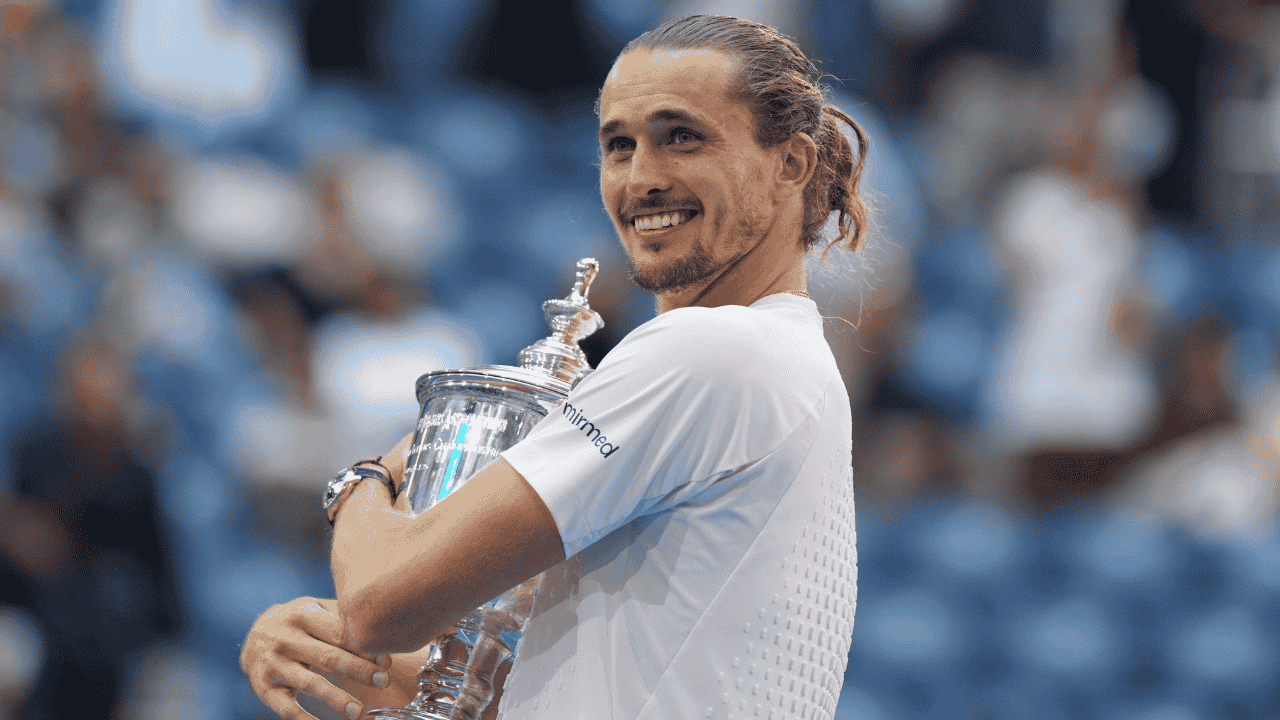
UPSC Current Affairs: Alexander Zverev Wins 2026 US Open | Daily GK Update
Introduction: A Historic Triumph at Flushing Meadows
On September 13, 2026, the global sporting landscape witnessed a monumental milestone as Germany's Alexander Zverev defeated American contender Ben Shelton to capture the 2026 US Open Men's Singles Championship. Concluding a gruelling tournament that tested the physical and mental endurance of the world's elite athletes, Zverev emerged victorious with a scoreline of 6-3, 7-6(2), 5-7, 6-2 inside the iconic Arthur Ashe Stadium in New York. The victory represents Zverev's second Grand Slam title of the year—and of his career—following his maiden triumph at the French Open (Roland Garros) earlier in the spring.
The triumph holds profound historical significance. At 29 years of age, Zverev became the first German male player to win the US Open singles title in the Open Era since Boris Becker achieved the feat 37 years ago in 1989. Furthermore, the tournament victory consolidated Zverev's status as a dominant force in the sport, erasing the ghosts of his 2020 US Open final defeat. For aspirants utilizing Atharva Examwise current news platforms, this sporting event transcends a mere athletic contest. It serves as a multidimensional case study encompassing international sports governance, historical milestones in the Open Era, socio-economic debates regarding prize money parity, and the intersection of medical science with elite athletic performance.
The 2026 US Open: Match Analytics and Statistical Significance
The championship match between Alexander Zverev and Ben Shelton was a study in strategic contrast, pitting Zverev's relentless baseline consistency and tactical patience against Shelton's explosive power and formidable service game. Entering the match, the 23-year-old Shelton carried the immense weight of American expectations, attempting to become the first American man to win a Grand Slam singles title since Andy Roddick at the 2003 US Open, and the first Black American man to win the championship since Arthur Ashe in 1968.
Zverev's path to the championship was characterized by unprecedented endurance. Over the course of the two-week tournament, the German spent a staggering 23 hours and 11 minutes on the court. This represents the second-highest amount of time spent on court by a US Open champion, trailing only Carlos Alcaraz's record of 23 hours and 39 minutes established in 2022. Zverev also became the first No. 1-seeded man in the Open Era to be forced into five-set matches in each of his first two rounds at the US Open, before streamlining his performance to drop only one set in the final.
The final itself, which spanned nearly three and a half hours, saw Zverev dismantle the American's game with surgical precision. Zverev capitalized on Shelton's early nerves, securing the first set after Shelton committed crucial double faults. In the second set, the German maintained his composure amidst a heavily partisan crowd—which fervently supported the home favourite—and executed a near-flawless tiebreaker to take a commanding two-set lead. Although Shelton demonstrated immense resilience to break Zverev's serve and capture the third set, the German immediately broke back at the beginning of the fourth set and powered through to a 6-2 conclusion.
Statistically, Zverev's performance was masterful. He registered a 70% first-serve percentage, winning 85% of his first-serve points. Despite Shelton firing serves that exceeded 140 mph, Zverev's defensive returns—specifically targeting Shelton's backhand wing to neutralize his pace—proved insurmountable. The victory marked Zverev's sixth consecutive win against American opponents, his 26th career ATP singles title, and his 60th career victory against top-10 ranked players. In a moment of sheer exhaustion and disbelief on match point, as Shelton's forehand return sailed beyond the baseline, Zverev did not immediately realize he had won the championship, retreating to the baseline to prepare for the next point before the umpire's declaration prompted his historic celebration moments later.
| Player | Aces | Double Faults | 1st Serve % | 1st Serve Points Won | Break Points Won | Total Points Won |
|---|---|---|---|---|---|---|
| Alexander Zverev | 9 | 6 | 70% | 85% | 4/6 | 125 |
| Ben Shelton | 10 | 4 | 74% | 71% | 1/3 | 113 |
For further reading on international sports records, consult the Atharva Examwise Daily GK Updates.
Alexander Zverev: Personal Adversity and Resilience
To comprehend the magnitude of Zverev's achievement, an analysis of his background and the personal adversities he has overcome is essential. Born in Hamburg, Germany, in 1997, Alexander "Sascha" Zverev hails from a deeply entrenched tennis lineage. Both of his parents, Irina Zvereva and Alexander Zverev Sr., were professional tennis players for the Soviet Union before relocating to Germany in 1991.
His older brother, Mischa Zverev, is also a former professional player who achieved a career-high ranking of World No. 25. The familial bond is famously strong, demonstrating the psychological dimensions of elite sports. In a notable incident showcasing this bond, during a gruelling match between the two brothers that had spanned nearly three hours, Alexander was leading 3-2 in the final set. Despite victory being imminent, he felt extremely uncomfortable with the prospect of defeating his older brother and made the unprecedented decision to voluntarily retire from the match, effectively forfeiting the victory to Mischa.
Beyond familial ties, Zverev is famously accompanied on the global tour by his two dogs, Mishka and Buba. The two canines, who are biological brothers of German origin, are integral to Zverev's psychological grounding during the intense eleven-month tennis season. Mishka regularly travels with Zverev to global tournaments, a logistical challenge that has required the athlete to charter private jets extensively over recent months to ensure their presence. The dogs have even amassed a substantial following on dedicated social media accounts.
The Challenge of Type 1 Diabetes
The most defining challenge of Zverev's narrative, however, is a profound medical condition. At the age of four, he was diagnosed with Type 1 Diabetes (T1DM), a chronic autoimmune condition characterized by the pancreas's inability to produce insulin. Medical professionals initially cautioned his parents that pursuing a career in elite, highly demanding competitive sports would be nearly impossible due to the rigorous physiological toll of the disease. In his emotional victory speech following the US Open triumph, Zverev dedicated the championship to his mother, recalling her steadfast refusal to allow the diagnosis to dictate his future. Her assertion that "this illness will not define us" became the psychological bedrock upon which Zverev built his Hall of Fame-calibre career.
For years, Zverev managed his condition privately, occasionally administering insulin in locker rooms to avoid public scrutiny. However, in 2022, he publicly disclosed his diagnosis to raise awareness and combat the stigma associated with chronic illnesses in professional athletics. This transparency has fundamentally altered the public perception of the athlete, transforming him into a global ambassador for diabetic individuals and proving that metabolic disorders do not preclude absolute excellence on the world stage.
Medical Science and Elite Athletics: The Physiology of Type 1 Diabetes
The intersection of elite athletic performance and Type 1 Diabetes offers a critical study in sports medicine and human physiology, forming an essential component of the Science and Technology syllabus for the UPSC examination. Understanding how an endurance athlete like Zverev manages to compete at the highest echelons of tennis for over three hours requires an examination of cellular metabolism and endocrinology.
In a healthy individual, the pancreas secretes insulin, a hormone that facilitates the cellular uptake of glucose from the bloodstream, primarily via the translocation of GLUT4 transporters to the cell membrane in skeletal muscles. During physical exertion, the body's sympathoadrenal drive naturally suppresses endogenous insulin secretion to prevent hypoglycemia (dangerously low blood sugar) while increasing the mobilization of lipids and glucose to fuel the contracting muscles.
For athletes with T1DM, this autoregulatory mechanism is absent. They rely entirely on exogenous (externally administered) insulin. Because exogenous insulin remains active in the subcutaneous tissue and bloodstream, it cannot be instantly suppressed at the onset of exercise. Consequently, an athlete with T1DM often enters a match in a relatively hyperinsulinemic state. This elevated insulin level, combined with the heightened insulin sensitivity induced by aerobic exercise, drastically increases the risk of severe hypoglycemia during a match. If an athlete's blood glucose drops too low, it can lead to autonomic and neurogenic dysfunction, manifesting as tachycardia, dizziness, cognitive impairment, or loss of consciousness.
Conversely, the intense psychological stress and anaerobic bursts required in professional tennis—such as sprinting and serving—trigger the release of catecholamines (like adrenaline and cortisol). These stress hormones stimulate the liver to release stored glucose into the blood. Without adequate insulin to usher this newly released glucose into the cells, the athlete risks hyperglycemia (excessively high blood sugar) and diabetic ketoacidosis, which severely impairs cognitive function, increases dehydration, and induces rapid fatigue.
Managing this metabolic tightrope requires relentless precision. Athletes must meticulously balance their carbohydrate intake (often requiring 30-60 grams of exogenous carbohydrates per hour during intense exertion) against highly calculated micro-adjustments to their basal and bolus insulin doses. The advent of Continuous Glucose Monitoring (CGM) systems has revolutionized this process, allowing athletes to track interstitial glucose levels in real-time without the need for traditional capillary blood testing. For external validation of these medical guidelines, refer to the World Health Organization (WHO) Guidelines on Diabetes. Zverev's ability to maintain world-class cognitive and physical acuity over a 23-hour cumulative tournament timeline stands as a monumental triumph of modern sports medicine, nutritional science, and personal discipline.
Philanthropy and Telemedicine: The Alexander Zverev Foundation
Translating personal adversity into systemic impact, the tennis champion established the Alexander Zverev Foundation in 2022, headquartered in his hometown of Hamburg, Germany. The foundation operates with a primary mandate to support children and young adults globally who are afflicted with Type 1 Diabetes. Recognizing the stark socio-economic disparities in global healthcare access, a core pillar of the foundation is the provision of life-saving insulin and essential medical supplies to children in developing nations where such treatments are often prohibitively expensive or entirely inaccessible.
Furthermore, the foundation intersects with advanced digital health research. It actively funds projects such as the "Challenge-D" initiative spearheaded by the Hasso Plattner Institute (HPI). This research project focuses on the telemedical care of elite athletes with Type 1 Diabetes. By leveraging digital health technologies, the initiative continuously analyzes data from insulin pumps, continuous glucose monitoring systems, and physiological training metrics. The synthesis of this biomedical data allows endocrinologists and sports scientists to formulate individualized, data-driven therapeutic adjustments in real-time, optimizing the athlete's performance and health irrespective of their global location. This paradigm of utilizing digital health interventions to manage non-communicable diseases represents a critical advancement in modern telemedicine and stands as a highly relevant topic for the public health and technology sectors of competitive exam syllabi.
The ATP Rankings Landscape and the Shifting Global Hierarchy
Zverev's triumph in New York significantly altered the landscape of the ATP singles rankings. By securing the 2,000 ranking points awarded to Grand Slam champions, Zverev accrued a total of 9,690 points, elevating him to World No. 2. This ascension closed the gap with the current World No. 1, Italy's Jannik Sinner, who retained the top spot with 11,500 points despite missing the US Open due to a knee injury.
The 2026 season has been characterized by a complex, fragmented dominance at the top of men's tennis. While the young prodigies Carlos Alcaraz and Jannik Sinner were universally recognized as the sport's new vanguard, both suffered substantial injury setbacks during the crucial summer hard-court swing. Zverev capitalized masterfully on this vacuum. In a remarkable statistical anomaly, despite winning two Grand Slam titles in a single calendar year, Zverev maintained a surprisingly poor 2-8 win-loss record against top-10 ranked opponents prior to the US Open final. Historically, the ATP ranking system rewards consistency and endurance across the grueling 11-month calendar over isolated instances of peak performance. Zverev's capacity to remain physically robust—surviving 25 Grand Slam matches with only two defeats over the year—allowed him to harvest points while his primary rivals faltered physically.
When questioned by the media regarding his status as the best player in the world following his US Open victory, Zverev displayed acute self-awareness and analytical objectivity. He conceded that his rise to World No. 2 was facilitated by the absences of Sinner and Alcaraz, candidly acknowledging that when all players were at peak health earlier in the season, Sinner was undoubtedly the superior competitor. This shifting dynamic, coupled with Novak Djokovic's unprecedented exit from the ATP top 10 following a first-round defeat at Flushing Meadows—marking the first time since October 2002 that no member of the "Big Three" (Djokovic, Nadal, Federer) occupies a top-10 position—signals a definitive generational transition in the sport's hierarchy.
| Rank | Player | ATP Points (Post 2026 US Open) | Major Titles in 2026 |
|---|---|---|---|
| 1 | Jannik Sinner | 11,500 | 1 (Australian Open) |
| 2 | Alexander Zverev | 9,690 | 2 (French Open, US Open) |
| 3 | Carlos Alcaraz | 7,160 | 1 (Wimbledon) |
| 4 | Felix Auger-Aliassime | 4,640 | 0 |
| 5 | Novak Djokovic | 3,770 | 0 |
Static GK and History: The Open Era and Grand Slam Evolution
To fully appreciate the context of Zverev's 43rd Grand Slam main draw appearance—and his status as the second German man in the Open Era to win the US Open—an analysis of the historical evolution of professional tennis is required. The term "Open Era" represents a fundamental watershed moment in the sport's history, officially commencing in April 1968.
Prior to 1968, the international tennis landscape was defined by a strict, and often hypocritical, dichotomy between "amateur" and "professional" players. The four major tournaments—the Australian Championships, the French Championships, Wimbledon, and the US National Championships—were exclusively reserved for amateur athletes. These amateurs were forbidden from accepting prize money for their participation, supposedly competing purely for the prestige and love of the sport. However, the reality was plagued by "shamateurism," where top players secretly received under-the-table payments and extensive expense accounts from national federations to maintain their amateur status.
Conversely, players who formally turned professional to earn a legitimate living were banished from the sport's most prestigious tournaments. They were relegated to independent barnstorming tours and separate professional championships, playing head-to-head exhibitions across the globe. This artificial segregation meant that the amateur Grand Slam champions were rarely competing against the absolute best players in the world, heavily diluting the competitive integrity of the sport.
Recognizing the unsustainable nature of this division, the British Hard Court Championships in Bournemouth, followed shortly by the French Open at Roland Garros in May 1968, shattered the barrier by allowing both professionals and amateurs to compete in the same draw. This initiated the "Open Era," universally opening the Grand Slams to all athletes and legally sanctioning the distribution of prize money. The transition catalyzed a commercial explosion in tennis, leading to global television broadcasts, massive corporate sponsorships, and the establishment of the modern tour structure. It also established the baseline from which all modern tennis records are measured; achievements are historically categorized as either pre-Open Era or Open Era to provide appropriate contextual comparison.
The Lineage of the US Open
The US Open, originally known as the U.S. National Championships, is a tournament steeped in transformation. Established in 1881, the inaugural event was held on the grass courts of the Newport Casino in Rhode Island. The tournament eventually relocated to the West Side Tennis Club in Forest Hills, New York, in 1915.
In a unique historical quirk, the US Open is the only Grand Slam tournament to have been played on three different surfaces. It was contested on natural grass from 1881 to 1974. In response to complaints regarding the unpredictable bounce of the grass and a desire for better television optics, the tournament transitioned to green Har-Tru clay from 1975 to 1977. Finally, in 1978, the tournament moved to its current home at the USTA Billie Jean King National Tennis Center in Flushing Meadows, Queens, transitioning to a synthetic hard court surface (initially DecoTurf, later Laykold). The hard court surface offers a medium-fast pace vector and uniform rebound elasticity, heavily favoring aggressive baseliners like Zverev.
In the men's singles category, the record for the most US Open titles in the Open Era is jointly held by Jimmy Connors, Pete Sampras, and Roger Federer, each securing the championship five times. Prior to the Open Era, American legends Richard Sears, William Larned, and Bill Tilden each won the tournament seven times. Aspirants should cross-reference this data with Atharva Examwise Sports GK Modules for comprehensive tournament histories.
| Grand Slam | Location | Court Surface | Month Held |
|---|---|---|---|
| Australian Open | Melbourne, Australia | Hard Court (Plexicushion/GreenSet) | January |
| French Open (Roland Garros) | Paris, France | Red Clay | May–June |
| Wimbledon Championships | London, United Kingdom | Natural Grass | June–July |
| US Open | New York, USA | Hard Court (Laykold/DecoTurf) | Aug–Sept |
Sports Governance: Institutional Architecture of Global Tennis
The governance structure of international tennis is a highly complex matrix of organizations, a topic frequently targeted by the Union Public Service Commission (UPSC) in preliminary examinations (e.g., UPSC Prelims 2021). Aspirants must discern the distinct jurisdictions of the various governing bodies to navigate such questions successfully.
Unlike standard weekly tour events, the four Grand Slam tournaments are neither owned nor operated by the Association of Tennis Professionals (ATP), which governs the men's tour, nor the Women's Tennis Association (WTA), which oversees the women's tour. Instead, the Grand Slams are independent entities, primarily governed by their respective national tennis federations (Tennis Australia, Fédération Française de Tennis, the All England Lawn Tennis Club, and the United States Tennis Association).
To ensure standardization across these four distinct pillars, the tournaments operate under a shared governance structure known as the Grand Slam Board. Comprising the chairmen of the four tournaments and the President of the International Tennis Federation (ITF), the Grand Slam Board maintains the unified Grand Slam Rule Book, oversees joint commercial properties, and coordinates relationships with the ATP and WTA regarding ranking points and scheduling.
The International Tennis Federation (ITF), established in 1913 and headquartered in London, serves as the overarching global governing body for the sport. While the ATP and WTA manage the day-to-day professional tours, the ITF is responsible for the administration of the Grand Slams, the global anti-doping program (acting in tandem with WADA policies), and international team competitions such as the Davis Cup (men) and the Billie Jean King Cup (women). In the context of India, tennis administration operates under the All India Tennis Association (AITA), which is a National Sports Federation recognized by the Ministry of Youth Affairs and Sports and is subject to the Right to Information (RTI) Act, falling under Entry 33 of the State List in the Indian Constitution.
Regarding entry requirements, the Grand Slam rulebook stipulates that the tournaments are an "Open Competition." They are theoretically open to any internationally ranked player above the age of 14, provided their official ATP or WTA ranking is high enough (generally 500 or better) to secure direct entry or a place in the qualifying draw. Furthermore, while standard ATP and WTA tour events place strict limits on the number of discretionary 'Wild Cards' a player can receive over a season to prevent abuse of the system, the autonomous Grand Slam Rule Book explicitly maintains a "No Limitation" policy. There is no collective restriction on the number of wild cards a player may receive to compete in Grand Slam tournaments throughout their career, preserving the independent discretion of each national federation to invite players based on regional interest or historical pedigree.
Socio-Economic Dimensions: Prize Money Parity and Commercialization
The 2026 US Open highlighted not only elite athletic performance but also the staggering commercial scale of modern sports. The tournament offered a record-breaking $108 million in total player compensation, reflecting a robust 20% increase from the previous year and a 44% surge since 2024.
Alexander Zverev's victory earned him a historic $5.5 million winner's cheque, the largest single payout in Grand Slam history. Crucially, the women's singles champion, Elena Rybakina, received the exact same $5.5 million payout. This financial parity is not an organic coincidence but the result of a protracted historical struggle for gender equality in sports economics.
In 1972, American tennis icon Billie Jean King won the US Open but earned $15,000 less than her male counterpart, Ilie Nastase. In a watershed moment for sports advocacy, King threatened a mass boycott of the 1973 tournament by female players unless financial parity was instituted. Through aggressive lobbying and by securing corporate sponsorship from Bristol Myers Squibb to bridge the financial gap, King successfully forced the United States Tennis Association's hand. Consequently, in 1973, the US Open became the first major sporting event in history to offer equal prize money to both male and female competitors. The subsequent formation of the WTA in 1973 and King's victory in the highly publicized "Battle of the Sexes" match against Bobby Riggs permanently altered the trajectory of women's sports, establishing a precedent that the other three Grand Slams eventually adopted (with Wimbledon and the French Open finally conceding to equal pay in 2007).
The sheer scale of the US Open prize pool offers a striking socio-economic juxtaposition when compared to other global sports. For instance, on the exact same day that Zverev and Rybakina each claimed $5.5 million in New York, the Indian women's cricket team secured the Women's Asia Cup in Dubai, for which the entire team was awarded a total prize purse of $25,000. This implies that a single US Open tennis champion earned 220 times the combined prize money of the continental cricket champions. While tennis relies on a hyper-commercialized ecosystem built on global television rights, massive corporate sponsorships, and individual branding at Grand Slam events, women's cricket remains entrenched in a developmental economic phase reliant on national boards. This disparity serves as a vital analytical lens for understanding the macroeconomics of global sports, highlighting how historical infrastructure, individual vs. team dynamics, and soft power shape the financial valuation of athletes.
Furthermore, the taxation of such vast sums is a complex legal reality. Despite winning $5.5 million, Zverev is subject to substantial fiscal deductions. Under US federal law, 37% of the winnings are withheld for top-tier income, compounded by an additional 9.65% state tax levied by New York. This dual taxation results in a deduction of approximately $2.5 million, leaving the champion with a net payout of roughly $2.9 million. However, as a resident of Monaco—a principality renowned for its lack of personal income tax—Zverev circumvents further domestic taxation upon repatriation of his earnings, illustrating the intersection of international sports and global wealth management.
| 2026 US Open Finish | Prize Money (USD) |
|---|---|
| Champion | $5,500,000 |
| Runner-Up | $2,800,000 |
| Semi-Finalist | $1,450,000 |
| Quarter-Finalist | $780,000 |
| Round of 128 (First Round) | $140,000 |
Why this matters for your exam preparation
For dedicated candidates leveraging Atharva Examwise platforms for the UPSC Civil Services Examination and State PSCs, the 2026 US Open provides a wealth of multidimensional data that maps directly onto the core syllabus.
Key Facts
Open Era Milestones: Alexander Zverev became the first German male to win the US Open in 37 years, succeeding Boris Becker (1989).
US Open Surface History: The US Open is the only Grand Slam to have been played on three different surfaces (Grass, Clay, and currently Hard Court).
Gender Pay Parity: The US Open was the first Grand Slam to implement equal prize money for men and women in 1973, spearheaded by Billie Jean King.
Prize Money 2026: Total player compensation for the 2026 US Open was a record $108 million, with the singles winners receiving $5.5 million each.
Exam-Relevant Data
General Studies Paper I (History & Sociology): The transition to the Open Era in 1968 and the socio-cultural evolution of gender parity in sports (Billie Jean King's 1973 campaign) are vital case studies for examining women's movements, the dismantling of class-based barriers, and societal shifts in the 20th century.
General Studies Paper II (Governance & Polity): The institutional architecture of tennis serves as a microcosm of global governance. Aspirants must understand the distinct jurisdictions of the International Tennis Federation (ITF), the ATP, the WTA, and the Grand Slam Board. Specific rules, such as the age requirement (14 years) and the "No Limitation" rule on Wild Cards at Grand Slams, have historically appeared in UPSC Prelims (e.g., 2021). Furthermore, understanding how the All India Tennis Association (AITA) interfaces with the RTI Act and the Ministry of Youth Affairs and Sports is highly relevant for Indian polity.
General Studies Paper III (Science & Technology): Alexander Zverev's management of Type 1 Diabetes provides a crucial case study in human physiology and endocrinology. Aspirants must grasp the biological mechanisms of insulin, the function of GLUT4 transporters, and the physiological distinctions between endogenous and exogenous hormonal responses. The application of Continuous Glucose Monitoring (CGM) and telemedicine (via the HPI Challenge-D project) represents the practical application of digital health technologies.
General Studies Paper III (Economics): The economic disparity between the $108 million prize pool of the US Open and events like the Women's Asia Cup ($25,000) highlights macroeconomic forces in the commercialization of sports. It provides a real-world framework for discussing broadcasting rights, international taxation policies (such as Monaco residency tax exemptions), and the economic disparities inherent in globalized sporting ecosystems.