
UPSC Current Affairs Today: Gudimallam Parasurameswara Temple Architecture and History | Daily GK Update
The Parasurameswara Swamy Temple located at Gudimallam village in the Tirupati district of Andhra Pradesh represents one of the most vital landmarks in Indian archaeological history and ancient art studies. Enshrining a unique monolithic Shiva Linga dated between the 3rd century BCE and 1st century BCE, the site offers irreplaceable material evidence regarding the early development of Shaivism, indigenous sculptural traditions, and structural temple architecture in Peninsular India. For aspirants preparing for the Civil Services Examination and other national competitive tests, understanding the stratigraphy, iconographic motifs, and dynastic patronage associated with Gudimallam is essential for mastering ancient history and culture modules.
To support your preparation with high-yield study material, Atharva Examwise Current News and our Atharva Examwise Daily GK Update track critical historical monuments and archaeological discoveries.
Key Facts for Competitive Examinations
Geographical Location: Situated in Gudimallam village, Yerpedu mandal, Tirupati district (formerly Chittoor district), Andhra Pradesh, approximately 24 kilometers southeast of Tirupati city.
Historical Antiquity: The primary enshrined deity is dated to the Early Historic period (circa 3rd to 1st century BCE), making it recognized by scholars and the Archaeological Survey of India as one of the oldest extant Shiva Lingas continuously worshipped in the world.
Statutory Status: Declared a Protected Monument of National Importance under the care of the Archaeological Survey of India (ASI) since 1954.
Architectural Format: Built on an apsidal (gajaprishta or elephant-back) structural plan, illustrating the architectural transition from early Buddhist chaitya-grihas to standalone Hindu shrines.
Excavation Milestone: Systematically excavated in 1973 by renowned ASI archaeologist Dr. Inguva Karthikeya Sarma (I.K. Sarma).
Epigraphic Legacy: Contains major epigraphs recording royal patronage from the late Pallava, Bana, Chola, and Vijayanagara dynasties spanning over a millennium.
Historical Background and Art-Historical Importance
The Gudimallam Parasurameswara Temple stands in a rural landscape near Tirupati, yet its central deity holds an unequaled position in South Asian religious art. Valued by scholars as approximately 2200 years old, the Linga preserved within the sanctuary demonstrates that organized Shaiva worship flourished in Peninsular India during the pre-Christian era. The site represents a pivotal stage in Indian sculpture when deity representation shifted from purely aniconic symbols to combined anthropomorphic imagery.
While daily rituals continue uninterrupted at the shrine, major cultural gatherings occur during Mahashivratri, attracting thousands of pilgrims alongside art historians and archaeologists. The local nomenclature "Parasurameswara" stems from the deity's physical depiction holding a parasu (battle-axe), which folklore links to the puranic penance of Sage Parasurama. However, historical analysis demonstrates that the icon embodies an earlier, pan-Indian Shaiva tradition blending Vedic, tribal, and indigenous guardian (Yaksha) motifs.
Iconographic Manifestation of the Monolithic Deity
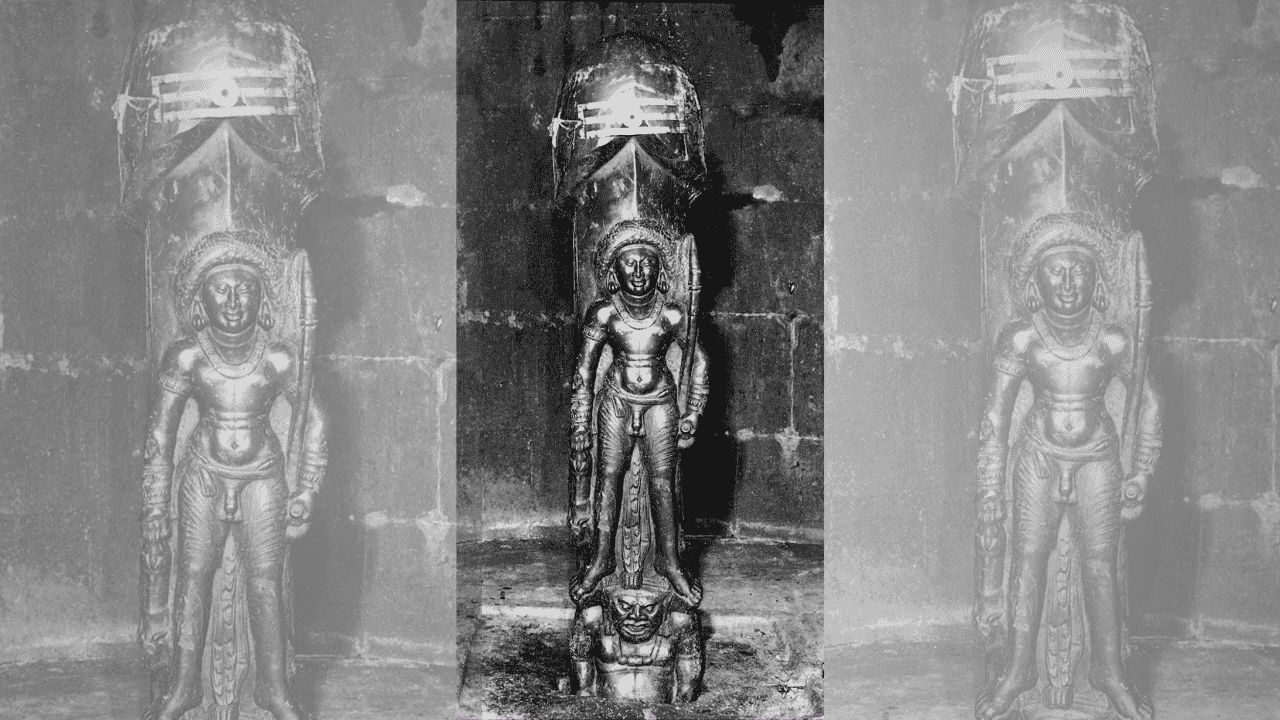
The primary deity of the Parasurameswara Temple stands at a height of approximately $1.5\text{ meters}$ (around $5\text{ feet}$) within the subterranean garbhagriha (sanctum sanctorum). Sculpted from a single shaft of dark, highly polished igneous rock (local Tirupati khandolite granite), the Linga uniquely unifies phallic and human forms.
The relief figure carved on the front surface of the shaft depicts Lord Shiva standing directly upon the shoulders of a crouching dwarf or Yaksha (Amarapurusha or Gana). The deity is two-armed: the right hand holds a parasu (axe) resting over the shoulder, while the left hand holds a small deer (mruga) suspended by its hind legs, alongside a small liquid container (kamandalu). The deity wears a thin, tightly draped lower garment (dhoti) secured by a patterned waist sash, but notably lacks the formal yajnopavita (sacred thread) that became standard in post-Gupta iconography.
The base Yaksha figure exhibits leaf-like ears, a shrunken torso, an open mouth displaying teeth, and lower limbs ending in feet resembling those of an elephant. Stylistically, the heavy facial features, muscular rendering, and naturalistic modeling mirror the early Sunga and Satavahana sculptures of Bharhut, Sanchi, Mathura, and Amaravati. This establishes the Gudimallam image as an essential benchmark for dating early Indian plastic art.
Archaeological Stratigraphy and Chronological Phases
The scientific understanding of Gudimallam was transformed by problem-oriented excavations conducted inside the sanctum by Dr. I.K. Sarma of the ASI in 1973. By temporarily removing the granite floor slabs and later square pedestal surrounds, archaeologists exposed three distinct cultural phases underneath the visible stone structure.
| Stratigraphic Phase | Historical Period & Age | Architectural Context & Structural Remains | Associated Cultural Artifacts & Ceramics |
|---|---|---|---|
| Phase I | c. 2nd – 1st Century BCE (Early Historic) | Open-air savedika linga. Linga shaft set into circular pithas and enclosed by a square stone rail (vedika) measuring $1.35\text{ m}$ per side. | Black-and-Red Ware (BRW), dull red pottery, iron objects, cut domestic sheep bones, and a single silver punch-marked coin. |
| Phase II | c. 1st – 3rd Century CE (Satavahana-Ikshvaku) | First enclosed structural shrine. A brick apsidal (gajaprishta) temple built around the Linga unit with a lime-plastered floor. | Russet-coated White-painted pottery, large baked bricks measuring $42 \times 21 \times 6\text{ cm}$, and terracotta tile fragments. |
| Phase III | c. 9th – 18th Century CE (Pallava to Vijayanagara) | Complete replacement in stone. Granite adhisthana, pillared mandapas, and outer enclosure walls erected over earlier foundations. | Inscribed granite slabs, Tamil and Sanskrit epigraphs, copper plates, and ritual bronze icons. |
The Phase I square stone railing (vedika) surrounding the Linga features upright posts (stambhas) and lenticular cross-bars (suchis) bearing floral carvings identical to the Buddhist railings at Bharhut and Amaravati. This structural sequence confirms that the Linga was originally worshipped in the open air as a savedika linga before being encased within brick and granite structures in later centuries.
Architectural Evolution: The Apsidal Gajaprishta Design
The extant stone complex of the Parasurameswara Temple presents an outstanding example of early South Indian structural engineering, characterized by its apsidal ground plan.
In Sanskrit architectural manuals (Silpa Sastras), an apsidal plan—semicircular at the rear and straight on the flanks—is termed Gajaprishta, reflecting its resemblance to the rounded contours of a crouching elephant's back. This floor plan was adapted from early Buddhist rock-cut chaitya-grihas and converted into standalone structural shrines for Hindu deities during the Satavahana, Ikshvaku, and Chola periods.
The elevation of the Gudimallam shrine incorporates several notable structural features:
The brick superstructure (vimana) crowning the apsidal sanctum is hollow inside and follows the Lingakriti design, where the external profile mirrors the shape of a Shiva Linga.
Three metallic finials (stupis) align along the ridge of the apsidal roof crown.
The floor level of the sanctum remains significantly lower than that of the attached antarala (vestibule) and maha-mandapa, preserving the ancient ground level of the original Phase I open-air shrine.
The temple layout progresses linearly from the apsidal sanctum through an antarala, a maha-mandapa, an ardha-mandapa, and an outer mukha-mandapa, all enclosed within a covered circumambulatory corridor (pradakshina-patha).
Dynastic Patronage and Epigraphic Heritage
While the central monolithic Linga dates to the pre-Christian era, the surrounding stone temple complex developed through successive layers of royal patronage over more than a thousand years. Epigraphs carved into the granite walls, pillars, and loose slabs record endowments from multiple major South Indian dynasties.
The earliest written epigraphs at the site belong to the late Pallava ruler Vijayadanti Vikrama Varman (circa 845 CE). These inscriptions record royal gifts of land, gold, and cattle dedicated to maintaining perpetual lamps and daily rituals for the deity, then recorded as Parasuramesvarasvamin.
Five Sanskrit and Tamil copper plates discovered at the site document grants by Bana kings, who ruled as regional chieftains. Inscriptions from the reign of King Vikramaditya II confirm the continued administrative and religious prominence of the shrine under Bana control.
The shrine underwent a major structural overhaul during the reign of the Imperial Cholas. In the 9th regnal year of Vikrama Chola (circa 1127 CE), the earlier brick temple was entirely rebuilt using dressed Tirupati granite blocks. Chola architects preserved the ancient apsidal layout while adding molded granite plinths (adhisthana) and outer wall niches (koshtas) housing sculpted figures of Ganesha, Brahma, and Vishnu.
During the 14th to 16th centuries CE, Vijayanagara rulers expanded the complex by adding outer perimeter walls, pillared pavilions, and secondary shrines dedicated to Goddess Anandavalli and Lord Subramanya.
To review additional updates on ancient historical monuments, explore our curated resources on Atharva Examwise UPSC Current Affairs.
Why this matters for your exam preparation
The study of the Gudimallam Parasurameswara Temple offers high-yield value for aspirants preparing for competitive examinations. The topic intersects directly with core syllabus components across historical, architectural, and archaeological domains:
UPSC CSE Prelims (General Studies Paper I): Questions frequently test knowledge of temple architectural styles (Nagara, Dravida, Vesara, and early Apsidal/Gajaprishta forms). Gudimallam provides a classic case study of an early apsidal structural shrine influenced by Buddhist chaitya plans.
Archaeological Methodology & Stratigraphy: Questions evaluate key excavations by the Archaeological Survey of India. Understanding Dr. I.K. Sarma's stratigraphy—moving from an open-air savedika linga to a Satavahana brick shrine and a Chola granite temple—provides crucial conceptual clarity.
UPSC CSE Mains (General Studies Paper I - Art & Culture): Analytical questions require candidates to trace the development of Indian iconography and religious synthesis. Gudimallam stands as the primary material example of early Shaiva iconography, illustrating the integration of aniconic phallic worship with anthropomorphic deity forms.
State Public Service Commissions (APPSC & Other State PCS): Regional history modules frequently cover site details, including its Location in Tirupati district, ASI protected status, and dynastic contributions from the Pallavas, Banas, Cholas, and Vijayanagara kings.
Sample Practice Questions for Aspirants
Prelims Practice Question
Q. Consider the following statements regarding the Parasurameswara Temple at Gudimallam:
The primary deity is a monolithic Shiva Linga featuring a relief of Lord Shiva standing upon a crouching dwarf figure.
Archaeological excavations proved that the central Linga was originally established as an open-air savedika linga surrounded by a stone railing.
The extant stone temple sanctum is built on an apsidal (Gajaprishta) ground plan.
Which of the statements given above are correct? (A) 1 and 2 only
(B) 2 and 3 only
(C) 1 and 3 only
(D) 1, 2, and 3
Correct Answer: (D) 1, 2, and 3
Explanation: All three statements are correct. The monolithic Linga depicts Shiva standing on a dwarf; 1973 excavations confirmed an early open-air savedika linga phase with a square railing; and the stone sanctum follows an apsidal Gajaprishta plan.
Mains Practice Question
Q. "The excavations at the Gudimallam Parasurameswara Temple provide crucial material evidence for tracing both architectural evolution and iconographic synthesis in early Peninsular India." Analyze this statement with reference to the site's structural phases and sculptural features. (15 Marks, 250 Words)