
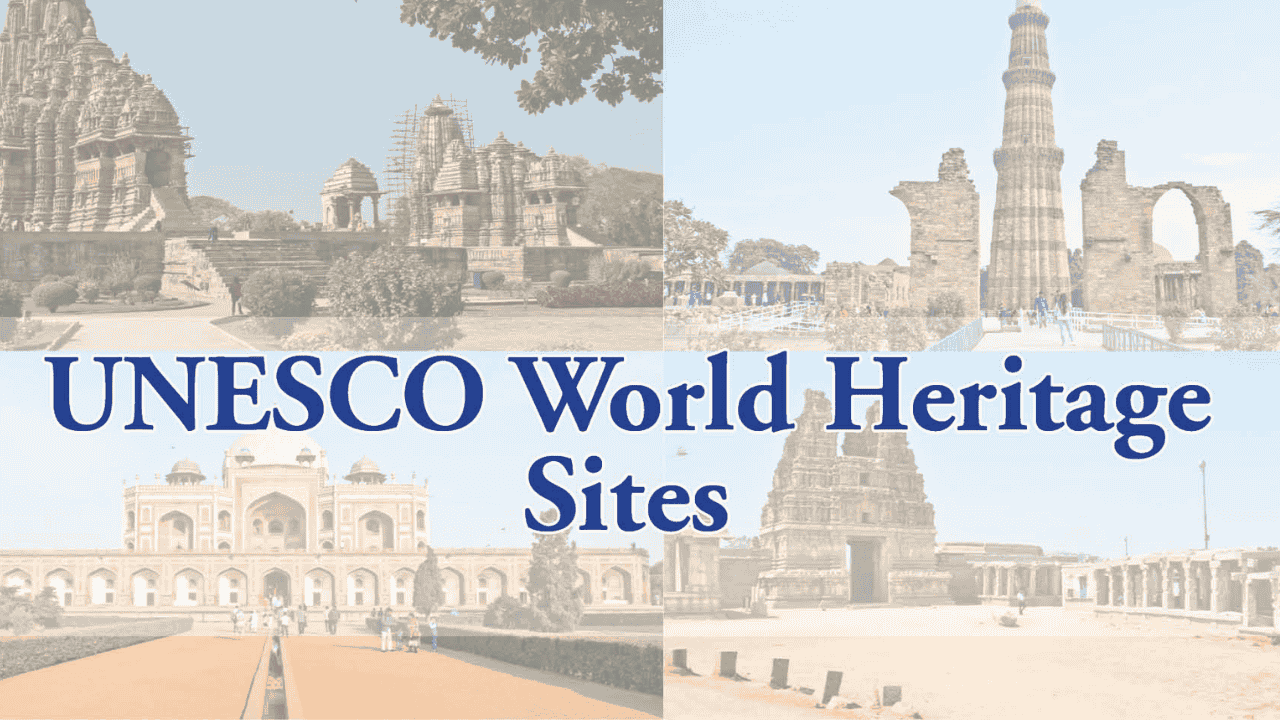
UNESCO World Heritage Sites Selection Process: UPSC Current Affairs & Daily GK Update
The designation of a landmark as a UNESCO World Heritage Site represents the global gold standard for cultural, historical, and natural preservation. Under the administration of the United Nations Educational, Scientific and Cultural Organization (UNESCO), properties inscribed on this prestigious list are recognized as possessing Outstanding Universal Value (OUV)—a level of significance so extraordinary that it transcends national boundaries and remains vital for all present and future generations of humanity.
Recent developments in India's cultural landscape have brought the total number of UNESCO World Heritage Sites in the country to 45. This comprehensive tally consists of 37 Cultural sites, 7 Natural sites, and 1 Mixed site. Among the landmark additions to India's heritage inventory is Sarnath, situated near Varanasi in Uttar Pradesh. Sarnath holds immense historical, architectural, and spiritual reverence as the sacred site where Gautama Buddha delivered his first sermon after attaining enlightenment.
For candidates following competitive exam news today, understanding the administrative, legal, and technical evaluation mechanisms that govern UNESCO site selection provides critical analytical grounding for questions across art, culture, international relations, and environmental conservation.
| Category of Heritage | Total Sites in India | Representative Examples | Evaluating Advisory Body |
|---|---|---|---|
| Cultural Sites | 37 | Taj Mahal, Ajanta Caves, Agra Fort, Sarnath | ICOMOS |
| Natural Sites | 7 | Kaziranga National Park, Keoladeo National Park, Sundarbans | IUCN |
| Mixed Sites | 1 | Khangchendzonga National Park | Joint ICOMOS / IUCN Review |
| Total Inscriptions | 45 | Nationwide Distribution | World Heritage Committee [cite: 2, 5] |
The Four-Stage Process of UNESCO World Heritage Selection
Securing World Heritage status is an intensive, multi-year sovereign and international process. UNESCO does not independently nominate places; instead, the responsibility rests entirely on the government of the host nation. The selection mechanism moves sequentially through four major institutional phases.
Phase 1: National Nomination via the Tentative List
The nomination path begins when a State Party—a nation that has signed and ratified the 1972 World Heritage Convention—compiles an inventory of its most valuable cultural and natural properties. This official inventory is termed the Tentative List.
UNESCO statutory rules mandate that any nominated property must remain listed on the nation's official Tentative List for a minimum of one full year before a formal application for inscription can be submitted. Ingestion into the Tentative List establishes a long-term strategy for heritage management and signals to the international community that a site is being prepared for formal evaluation.
Phase 2: Submission of the Comprehensive Nomination Dossier
After fulfilling the mandatory one-year waiting period on the Tentative List, the country's government prepares an exhaustive Nomination Dossier. Rather than a simple application form, this dossier represents a definitive scientific, historical, legal, and managerial portfolio.
The dossier must articulate precisely why the site holds international significance. It is submitted alongside detailed cartographic maps, extensive archaeological and scientific surveys, legal protection frameworks under domestic law, and an actionable long-term Management Plan detailing how the site will be conserved and maintained for posterity.
Phase 3: Field Evaluation by Global Technical Advisory Bodies
Once the World Heritage Centre verifies that the nomination dossier is complete, it transfers the documentation to independent international advisory bodies for field checks and scientific review. These expert bodies evaluate the site's authenticity, integrity, legal protection, and operational management.
The technical evaluation responsibilities are divided among three statutory advisory organizations:
ICOMOS (International Council on Monuments and Sites): Responsible for evaluating all cultural properties, such as ancient temples, historic cities, forts, and archaeological monuments.
IUCN (International Union for Conservation of Nature): Responsible for assessing all natural properties, including national parks, terrestrial biomes, marine reserves, and geological landforms.
ICCROM (International Centre for the Study of the Preservation and Restoration of Cultural Property): Serves as a technical advisory body specializing in conservation techniques, restoration science, and institutional capacity building.
These advisory bodies dispatch expert teams directly to the nominated locations to conduct on-site inspections, verifying whether the physical reality of the site aligns with the claims submitted in the dossier.
Phase 4: Final Adjudication by the World Heritage Committee
Following technical field assessments, the advisory bodies compile evaluation reports and recommendations for the UNESCO World Heritage Committee. The Committee consists of elected representatives from 21 member nations who convene annually to make final decisions regarding new inscriptions.
The 21-member World Heritage Committee holds exclusive decision-making authority. During its annual meetings, the Committee selects one of four possible administrative decisions for each nomination:
Inscription: Formally granting World Heritage status.
Referral: Requesting minor additional information or revised documentation from the nominating State Party.
Deferral: Requiring a complete restructuring of the nomination dossier or further long-term scientific studies before re-evaluation.
Non-Inscription: Rejection of the site's proposal for World Heritage listing.
The 10 Selection Criteria for Outstanding Universal Value
To qualify for inscription on the UNESCO World Heritage List, a candidate site must satisfy at least one of ten official selection criteria published in the Operational Guidelines for the Implementation of the World Heritage Convention. Criteria (i) through (vi) address cultural attributes, while Criteria (vii) through (x) govern natural features.
| Criterion Code | Heritage Type | Official Statutory Standard |
|---|---|---|
| Criterion (i) | Cultural | To represent a masterpiece of human creative genius. |
| Criterion (ii) | Cultural | To exhibit an important interchange of human values over a span of time or within a cultural area on developments in architecture, technology, monumental arts, town-planning, or landscape design. |
| Criterion (iii) | Cultural | To bear a unique or exceptional testimony to a cultural tradition or to a civilization which is living or which has disappeared. |
| Criterion (iv) | Cultural | To be an outstanding example of a type of building, architectural or technological ensemble, or landscape which illustrates a significant stage in human history. |
| Criterion (v) | Cultural | To be an outstanding example of a traditional human settlement, land-use, or sea-use representative of a culture, or human interaction with the environment. |
| Criterion (vi) | Cultural | To be directly or tangibly associated with events, living traditions, ideas, beliefs, or artistic and literary works of outstanding universal significance. |
| Criterion (vii) | Natural | To contain superlative natural phenomena or areas of exceptional natural beauty and aesthetic importance. |
| Criterion (viii) | Natural | To be outstanding examples representing major stages of Earth's history, including the record of life, ongoing geological processes, or significant geomorphic features. |
| Criterion (ix) | Natural | To be outstanding examples representing significant ongoing ecological and biological processes in the evolution and development of ecosystems and communities of plants and animals. |
| Criterion (x) | Natural | To contain the most important and significant natural habitats for in-situ conservation of biological diversity, including threatened species of OUV. |
Key Historical Milestones and Exam-Relevant Data
For candidates seeking a reliable daily GK update for competitive exams, mastering key facts and dates surrounding India's association with UNESCO is essential.
Essential Historical Timeline
1972: UNESCO officially adopts the Convention Concerning the Protection of the World Cultural and Natural Heritage, creating the global system for defining and protecting World Heritage Sites.
1977: India ratifies the World Heritage Convention treaty, formally committing to global conservation standards.
1983: India marks its first inscriptions on the World Heritage List with four iconic monuments:
Agra Fort (Uttar Pradesh)
Taj Mahal (Uttar Pradesh)
Ajanta Caves (Maharashtra)
Ellora Caves (Maharashtra)
Present Status: India hosts 45 UNESCO World Heritage Sites (37 Cultural, 7 Natural, and 1 Mixed).
Critical State-Wise and Regional Data
State with Maximum Sites: Maharashtra holds the highest number of UNESCO World Heritage Sites in India, with 6 recognized sites:
Ajanta Caves
Ellora Caves
Elephanta Caves
Chhatrapati Shivaji Maharaj Terminus (formerly Victoria Terminus)
Victorian Gothic and Art Deco Ensembles of Mumbai
Western Ghats (cluster shared across Western peninsular states).
India's Only Mixed Site: Khangchendzonga National Park in Sikkim, recognized in 2016 for fulfilling both cultural and natural criteria.
Key Buddhist Heritage Node: Sarnath, located near Varanasi, represents a core pillar of India's cultural submissions due to its direct association with Gautama Buddha's first sermon (Dharmachakrapravartana).
Post-Inscription Landscape: Rights, Responsibilities, and Danger List
Securing UNESCO recognition brings substantial advantages, but it also imposes binding international responsibilities on the host state.
Strategic Advantages of World Heritage Status
Global Recognition & Sustainable Tourism: World Heritage status elevates international visibility, boosting sustainable heritage tourism and associated local economic development.
Technical and Financial Assistance: Designated sites become eligible for technical guidance from ICCROM, expert training initiatives, and international funding allocations for restoration project emergency needs.
Enhanced Protective Laws: Inscription encourages domestic authorities to institute strict land-use policies, pollution control boundaries, and legal buffer zones around heritage complexes.
The List of World Heritage in Danger and Delisting Risks
World Heritage recognition is not permanent. State Parties must continuously maintain the site's physical condition, authenticity, and environmental integrity.
When a site faces acute threats—such as military conflict, unmonitored development, severe environmental pollution, unchecked urban expansion, climate change, or excessive tourism pressure—the World Heritage Committee can move the property to the List of World Heritage in Danger. Inclusion on the Danger List mobilizes international conservation assistance and urges the host country to implement immediate corrective measures. If the threat persists unmitigated over a long period and the site loses its OUV, UNESCO reserves the right to strip the location of its World Heritage status entirely.
Related Exam Resources on Atharva Examwise
Aspirants looking to strengthen their coverage of static GK and dynamic current affairs can explore additional study modules on the Atharva Examwise Platform:
Atharva Examwise Current News: Daily & Monthly roundups
UPSC Current Affairs: Comprehensive Analysis of Art & Culture Inscriptions
Indian Art and Culture: Cave Architecture of Ajanta, Ellora, and Elephanta
Environment & Ecology: Protected Area Networks, National Parks, and Biosphere Reserves
For direct international documentation and official lists, aspirants may consult authoritative portals such as the UNESCO World Heritage Centre Official Site.
Why This Matters for Your Exam Preparation
Understanding the UNESCO World Heritage Site selection process and tracking current affairs updates is vital for candidates preparing for UPSC Civil Services (CSE), State PSCs, and other national competitive examinations.
Relevance for General Studies Paper I (Art, Culture, and History)
Monuments & Dynastic History: Questions in GS Paper I routinely test architectural styles, patronage dynasties, and cultural origins of UNESCO sites (e.g., Mauryan, Gupta, Mughal, Pallava, or Chola architecture).
Integration of Static and Current News: UPSC frequently links current heritage news—such as Sarnath's recognition or Maharashtra's heritage density—to static history syllabus concepts, requiring candidates to know both historical context and technical selection mechanics.
Relevance for General Studies Paper III (Environment and Biodiversity)
Conservation Methodologies: Natural World Heritage Sites (Criteria vii–x) directly align with ecological syllabus topics such as biological diversity preservation, threatened species protection, and habitat conservation strategies.
International Conventions: Questions frequently probe the institutional mechanics of global treaties, such as the 1972 World Heritage Convention, its advisory bodies (IUCN, ICOMOS, ICCROM), and its interaction with domestic conservation laws.
Value for UPSC Prelims and Objective Competitive Exams
Fact-Based Precision: Objective prelims examinations test granular details, such as:
The total count of sites in India (45 sites: 37 Cultural, 7 Natural, 1 Mixed).
The administrative rules governing nominations (e.g., mandatory 1-year minimum tenure on the national Tentative List).
The distinct roles of advisory bodies (ICOMOS for cultural sites vs. IUCN for natural sites).
The composition and authority of the 21-member World Heritage Committee.