UPSC Current Affairs October 30, 2026: Dangi Dance of Gujarat, Tribal Heritage & Daily GK Update | Atharva Examwise Current News
Executive Summary: Competitive Exam News Today
In the domain of Indian Art, Culture, and Intangible Heritage (General Studies Paper I), indigenous tribal performance traditions represent a foundational pillar of UPSC current affairs and state civil services evaluations. Today's Atharva Examwise current news and daily GK update examines the Dangi Dance (Dangi Nritya), a vibrant, high-velocity communal folk dance indigenous to the forested Dang district of southern Gujarat and its contiguous tribal belt. Spotlighted in current affairs October 30, 2026, Dangi Nritya stands out in Indian ethnomusicology for its acrobatic mid-air human pyramids, its rapid serpentine formations (Shrinkhala), and a codified choreographic vocabulary comprising 27 distinct step patterns (Chaals) that mimic the biodiversity of the Western Ghats and Satpura ranges.
Beyond its aesthetic spectacle, Dangi Dance functions as a living anthropological archive of the Kunbi and Dangi Bhil communities. It encapsulates an animistic worldview rooted in ecological stewardship, communal egalitarianism, and a cross-border cultural synthesis bridging the linguistic and performative traditions of Gujarat and Maharashtra. Performed prominently during the historic Dang Darbar at Ahwa, Holi, Diwali, marriage ceremonies, and the Dungardev (hill deity) festival, this tradition offers serious aspirants a multidimensional case study connecting tribal ethnography, colonial forest history, and biogeographical determinism. For comprehensive foundational coverage of Indian Art and Culture alongside daily analytical updates, aspirants can explore the Atharva Examwise Current Affairs Portal and the structured NCERT Foundation Program.
Choreographic Architecture and Performative Mechanics of Dangi Nritya
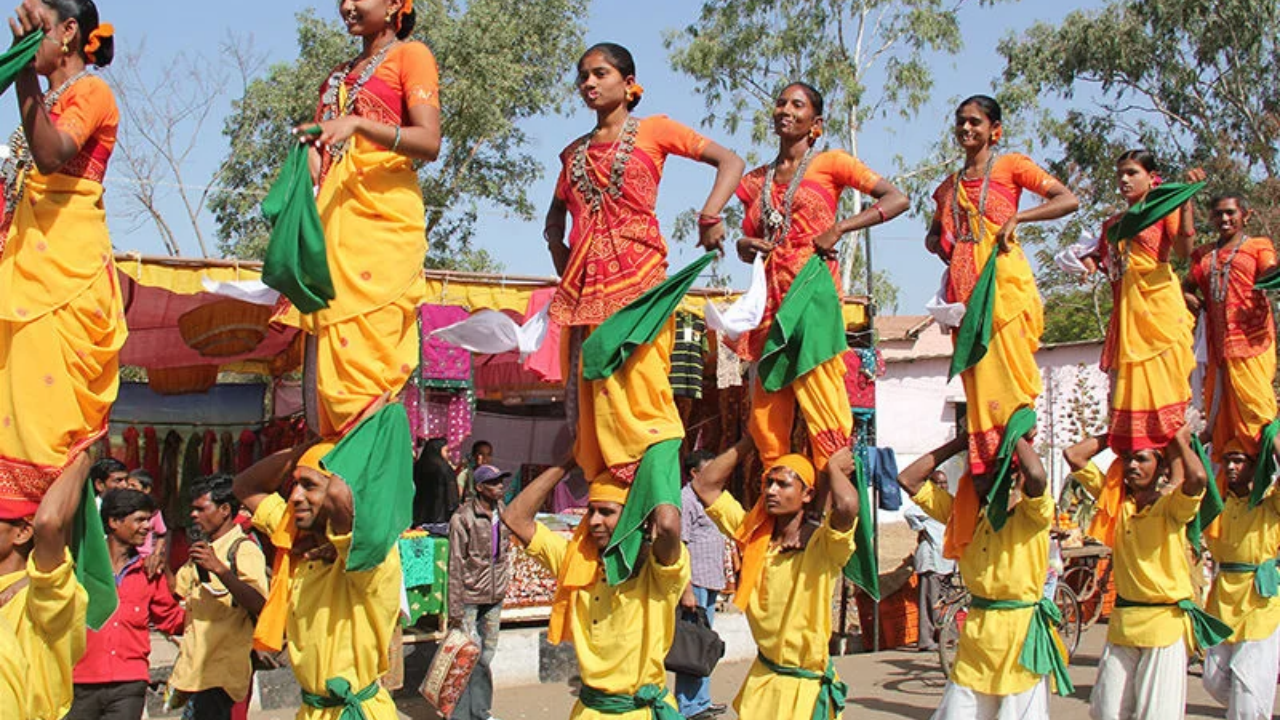
The structural hallmark of Dangi Nritya lies in its synthesis of collective kinetic speed and precision acrobatics, as documented in the WebIndia123 Cultural Archive on Dangi Dance. Unlike solo classical Indian dance forms that rely on codified hand gestures and facial expressions, Dangi Nritya is an egalitarian, community-wide kinetic expression in which men and women participate on an equal footing. Dancers link hands or clasp one another around the waist and shoulders to forge an unbroken human chain known as a Shrinkhala. Led by a principal dancer at the head of the formation, the chain accelerates rapidly, executing swift forward, backward, and concentric circular maneuvers that generate undulating, snake-like (serpentine) geometric patterns across the performance arena.
The 27 Chaals: Ecological Mimicry in Motion
A defining technical feature frequently highlighted in competitive exam news today is the concept of the Chaal (also transliterated as Chala). In Dangi choreography, each distinct variation of footwork, rhythm, and geometric formation is designated as a Chaal, and the traditional repertoire encompasses approximately 27 varieties of Chaals.
An examination of the underlying anthropology indicates that these 27 Chaals are not arbitrary rhythmic exercises; rather, they function as kinetic mimicry of the local forest fauna and natural environment. Because the Dangi tribes inhabit dense deciduous and semi-evergreen forests where wildlife is respected as an equal co-inhabitant of the ecosystem, dancers translate the locomotion of birds, reptiles, and mammals into rapid choreographic shifts executed within fractions of a second. Documented traditional Chaals include the sparrow step tune, the crocodile step tune, the chicken step tune, the two-step and three-step tunes, and the slow-motion and wailing tunes, alongside named regional formations such as Jopio Chalo, Mohania Chalo, Morno Chalo (peacock movement), Bahino Chalo, Malino Chalo, Zavda Chalo, Dhobing Chalo, and Thisra Chalo.
Mid-Air Human Pyramids and Acoustic Drivers
As the tempo builds gradually toward a crescendo, the performance culminates in its signature spectacle: the spontaneous construction of two- and three-tier human pyramids in mid-air before winding to a halt. Demonstrating extraordinary balance and collective trust, female dancers climb onto the shoulders of the male base dancers while the entire multi-tiered formation continues to rotate both clockwise and counter-clockwise without breaking rhythmic synchronization.
This high-energy athleticism is sustained by a continuous acoustic backdrop provided by indigenous percussion and wind instruments. The primary rhythmic engine is the Dangi Dhol (a large double-headed drum) paired with the Shehnai and the Pawri (also spelled Pavri or Tadpa). The Pawri is an indigenous wind instrument crafted from a dried hollow bottle gourd, bamboo pipes, and a horn bell, producing a resonant, bagpipe-like drone that regulates the transitions across the 27 Chaals. So central is the Pawri to the performance that in contemporary ethnographic literature, the Pavri Dance has become virtually synonymous with the overarching term Dangi Dance. During these performances, men wear a traditional loincloth (langoti) paired with a waistcoat and a brightly colored turban, while women adorn themselves in vibrant sarees, blouses, and heavy silver jewelry.
Ethnographic Taxonomy and Socio-Religious Cosmology of the Dangs
While Dangi Nritya (Pavri Dance) represents the most celebrated public showcase of the region, analytical precision for UPSC Prelims and Mains requires situating it within the broader socio-religious dance taxonomy of the Dang district. For the Kunbi, Dangi Bhil, Konkna, and Varli tribes of the region, dance is not merely secular entertainment but a vital socio-religious institution anchored in animism, ancestor worship, and ecological propitiation.
The Animistic Pantheon and Ritual Specialists
The spiritual life of the Dangi tribes revolves around an animistic recognition that trees, hills, rivers, serpents, and wild animals possess sacred spirits. Their indigenous pantheon includes Dungardev (the sovereign deity of hills and mountains), Wagh-Dev (the sacred tiger god and emblem of forest protection), Nag-Dev (the serpent deity), Kanasari Devi (the goddess of grain and agricultural abundance), and Gam-Dev (the village guardian spirit). Spiritual mediation within this cosmos is conducted by the Bhagat, an indigenous priest and medicine man who functions as the community's philosopher, guide, healer, and spiritual conduit during seasonal rites.
To understand how the Dungardev festival and Dangi Nritya operate within the wider cultural landscape, aspirants must distinguish among the four interconnected folk dances of the Dang region:
| Dance Tradition | Associated Tribe / Community | Primary Occasion & Ritual Purpose | Gender Participation | Core Musical Instruments | Defining Performative & Ritual Features |
|---|---|---|---|---|---|
| Dangi Nritya (Tadpa / Pavri Dance) | Kunbi & Dangi Bhil tribes | Holi, Dang Darbar, Diwali, marriages, & communal festivities | Men & women jointly in an egalitarian chain (Shrinkhala) | Dhol, Pawri (gourd-horn pipe), & Shehnai | 27 Chaals mimicking forest fauna; high-speed serpentine movement; 2- and 3-tier rotating human pyramids. |
| Bhaya Dance (Bhacha Chalo) | Dangi tribal communities | Worship of Dungardev (Hill God) & mountain boundary spirits | Communal devotees observing strict ritual austerity | Pawri (replaces Dholak and Kahalya) | Mandatory ritual bath before dancing; performers eat only one meal a day; chanting of "bi-lo-ri-sho" (invocation of hill stone boundaries). |
| Thakarya Dance | Dangi tribal men | Festival of Tera through Diwali; propitiation of rain gods | Exclusively male performers | Madal (percussion) & Tin | Begins with seated Naman Geet saluting Mother Earth, Wagh-Dev, & Kanasari Devi; performed in strenuous Virasan (warrior pose) with Q&A singing. |
| Bohada Dance | Originated with Konkna tribe; adapted across Dang | Socio-religious storytelling & recreation of oral tribal mythology | Masked community performers | Dholak, Kahalya, & Pawri | Elaborate mask dance using lightweight Pangara tree wood, bamboo (thati), clay, and papier-mâché masks to preserve unwritten oral history. |
Geopolitical, Historical, and Ecological Synthesis
A deeper analytical reading of Dangi Nritya reveals how physical geography and colonial administrative history directly shaped its cultural evolution and performative survival.
The Gujarat-Maharashtra Syncretic Corridor
Dangi Nritya is celebrated as an organic fusion of Gujarati and Maharashtrian cultures, blended harmoniously with ancient Dravidian and Bhil substrata. Geographically, the Dang district is bounded by Gujarat's Tapi and Navsari districts to the north and west, and Maharashtra's Nandurbar and Nashik districts to the east and south. During the British colonial era prior to the linguistic reorganization of states, Dang was administered as part of the Bombay Presidency and maintained deep economic and kinship ties with the Khandesh region of northern Maharashtra. Consequently, the spoken Dangi language evolved as a distinctive Indo-Aryan dialect heavily influenced by both Gujarati and the Khandeshi linguistic continuum, a cultural duality mirrored in the costuming, instrumentation, and Tamasha folk theater traditions accompanying Dangi festivities.
Colonial Forest Leases and the Historic Dang Darbar (1842–2026)
One of the primary institutional platforms for Dangi Nritya is the annual Dang Darbar (officially termed the Jamabandi Darbar), held over three to five days each year at the district headquarters of Ahwa just prior to Holi. As highlighted in The Times of India Report on Historic Dang Darbar, the 2026 edition of the festival was celebrated with grandeur at Ahwa from February 26 to March 3.
The origin of this festival dates back to 1842, when the British colonial administration sought to exploit the dense teak and timber forests of the Dangs. Following prolonged tribal resistance, the British signed forest lease agreements with the indigenous tribal chiefs, instituting an annual gathering (Darbar) at Ahwa to pay compensation for timber rights. After Indian Independence, the government took over the organization of the event and, in 1954, formally cancelled the feudal forest privileges of the tribal rulers, replacing them with hereditary political pensions. Even after privy purses for princely states were abolished nationwide, the hereditary political pensions of the five tribal kings of Dang—representing the principalities of Gadhavi, Pimpri, Amala-Linga, Vasurana, and Daher—along with their Naiks, were preserved as a unique historical entitlement. Every year at the Dang Darbar, the District Collector and state officials honor the five tribal kings in a grand ceremonial procession where local and visiting artists present the world-famous Dangi Dance.
Physiography and Biodiversity of the Dangs
The ecological vitality expressed in Dangi Nritya is directly sustained by the physical geography of the Dang district, which stands out as Gujarat's most densely forested region with 1,048 square kilometers of forest cover, accounting for 60% of its total geographical area. The district lies at the orographic junction where the Western Ghats in the south converge with the Satpura Range in the east, featuring rugged, hilly terrain with elevations ranging between 300 and 1,100 meters. Prominent elevated settlements within this belt include the administrative seat of Ahwa at 2,000 feet above sea level, Gujarat's premier hill station Saputara, and the high-altitude village of Don at 3,560 feet above sea level.
Receiving heavy annual precipitation between 1,500 and 3,000 mm, the northeastern mountains of Dang serve as the primary watershed for two major west-flowing rivers that empty into the Arabian Sea: the Ambika River (along with its tributary, the Khapari) and the Purna River (along with its tributary, the Gira). Supplemented by perennial streams such as the Koshmal, Vanar, Ukhatia, Morzira, Don, and Ambapada, this drainage network feeds approximately 21 waterfalls—most notably the Gira, Girmal, and Don waterfalls—and sustains the largest Botanical Garden in Gujarat alongside abundant minor forest produce including timber, bamboo, honey, wax, and lac. Aspirants seeking to master the intersection of Indian physical geography and cultural ecology can access comprehensive NCERT notes, mind maps, and infographics at the Atharva Examwise Study Material Hub and test their retention through the Current Affairs MCQ PDF Repository.
Key Facts & Exam-Relevant Data for Quick Revision
For aspirants compiling revision notes from today's daily GK update, the following bulleted pointers consolidate high-probability prelims and one-liner facts:
Dance Name & Region: Dangi Nritya (Dangi Dance), indigenous to the Dang district of southern Gujarat and adjoining tribal belts of northern Maharashtra.
Performing Communities: Primarily performed by the Kunbi, Dangi Bhil, Konkna, and Varli tribal communities.
Core Choreographic Features: Co-educational communal chain formation (Shrinkhala); rapid serpentine (snake-like) movements; 27 varieties of steps (Chaals) imitating forest birds and animals; and rotating two- to three-tier human pyramids.
Musical Accompaniment: Dangi Dhol (percussion), Pawri / Tadpa (wind instrument made of dried gourd, bamboo, and horn), and Shehnai.
Major Festivals & Occasions: Dang Darbar (Jamabandi Darbar) at Ahwa, Holi, Diwali, Dungardev Festival (hill deity worship via Bhaya dance), and tribal weddings.
Historical Link (Dang Darbar): Instituted in 1842 under British rule; post-1954, the State Government awards annual hereditary political pensions to the five tribal kings of Dang (Gadhavi, Pimpri, Amala-Linga, Vasurana, and Daher).
Geographic Indicators: Dang features 60% forest cover (1,048 sq km), straddles the Western Ghats and Satpura Range, and is drained by the west-flowing Ambika and Purna rivers.
Why this matters for your exam preparation
Integrating this UPSC current affairs analysis into static syllabus revision provides substantial utility across multiple stages of the Civil Services Examination and State PCS assessments, which are covered in depth through Atharva Examwise State PCS & MPPSC Coaching under Dr. Ajay Bhamoliya's concept-first visual methodology detailed at About Atharva Examwise. In the UPSC Preliminary Examination (General Studies Paper I), examiners frequently construct multi-statement questions matching regional folk dances with their respective states, indigenous tribes, and technical attributes—such as identifying the 27 Chaals, rotating human pyramids, the gourd-based Pawri wind instrument, or the Pangara wood masks utilized in the Bohada tradition. Simultaneously, the physiographic setting of the Dangs—marking the orographic convergence of the Western Ghats and Satpura ranges and the drainage basins of the west-flowing Ambika and Purna rivers—links cultural current affairs directly to core questions in Indian Physical Geography.
For the UPSC Mains Examination (General Studies Paper I and Paper II), Dangi Nritya and the associated Dungardev and Wagh-Dev worship traditions serve as concrete anthropological case studies illustrating the preservation of intangible cultural heritage and the symbiotic relationship between Adivasi communities and forest ecosystems. Analytical answers benefit from highlighting how tribal choreography codifies biodiversity conservation through faunal mimicry and reinforces gender egalitarianism, visibly demonstrated when female dancers form the apex of the communal human pyramid. Furthermore, the institutional evolution of the Dang Darbar from an 1842 British colonial timber-lease mechanism into a modern democratic cultural festival—where five tribal monarchs continue to receive state political pensions after the 1954 reforms—provides a nuanced historical example of asymmetric tribal integration and cultural accommodation in post-Independence India.